

Last Updated: October 24, 2026
Quick Summary
To encourage open-ended play at home, set up a yes space: a low, safe area where your child can reach everything without hearing no. Keep only a small, rotating set of materials out and step back, so your child decides what they become.
- Rotate the materials you leave out every week or two to keep attention high.
- Household items like boxes, wooden spoons and fabric scraps make strong open-ended play materials.
- Choose toys that are easy to grip, mix with other sets and leave the story open.
- Keep each play session short: fifteen to twenty minutes of focused play beats an hour of wandering.
- Say less than you think you should. Sit nearby, stay quiet, and let your child solve the small problems alone.
- Give a five-minute warning before tidy-up rather than packing up too soon.
Table of Contents
- Quick Summary
- Start With a Yes Space and a Few Good Materials
- Open-Ended Play Ideas That Work with What You Already Own
- Choosing Open-Ended Toys for Children Aged 3 and Up
- Simple Open-Ended Play Activities at Home
- How to Encourage Independent Play Without Directing
- Common Mistakes That Shut Play Down
- Conclusion
Start With a Yes Space and a Few Good Materials
The fastest way to encourage open-ended play at home is to set up a "yes space": a low, safe area where your child can reach everything without hearing "no". Fewer rules mean more play.
Start with these basics:
- A low shelf or basket at your child's height
- A soft rug or mat to define the play zone
- A small, rotating set of materials, not the whole toy box
- Clear containers so pieces are easy to find and put back
Rotate what is out every week or two. A short supply keeps attention high. Too much choice scatters focus.
Open-ended play is play with no fixed outcome, where the child decides what the materials become. That is why the space matters more than the toy count.
A storage tin or tidy basket helps you reset the space in seconds. It also makes the area easy for a child to manage alone.
Open-Ended Play Ideas That Work with What You Already Own
You do not need to buy anything to start. A few household items already make strong open-ended play ideas.
Try these first:
- Cardboard boxes in two or three sizes
- Wooden spoons, bowls and a colander
- Pegs, jar lids and clean bottle tops
- Fabric scraps, tea towels and scarves
- Paper tubes and plain paper
These materials have no single answer. A box becomes a boat, a shop, a bed. That flexibility is the whole point.
The Children & Nature Network research on open-ended materials notes that children are drawn to loose, movable materials and play longer when they can access a variety of them easily.
Keep the items in one basket and let your child lead. Resist the urge to suggest what the box "should" be.
One rule keeps this safe and simple: check items for sharp edges, small parts and loose paint before they go in the basket. Then step back.
Choosing Open-Ended Toys for Children Aged 3 and Up
Look for toys a child can use in many ways, not one. The best open-ended toys for children share three traits: they are easy to grip, they mix with other sets, and they leave the story open.
Here is how we would choose:
What to check |
Why it matters |
What to avoid |
|---|---|---|
Chunky, easy-grip pieces |
Small hands stay in control |
Tiny, fiddly parts |
Mix-and-match design |
Sets combine into new scenes |
Closed, single-use kits |
Durable materials |
Survives daily play |
Flimsy plastic that cracks |
Open story prompts |
Child invents the play |
Screens or fixed scripts |
Our magnetic play sets are built around these ideas. Each set, from Tiny Kiwi to Tiny Baker and Tiny Builder, uses chunky EVA foam pieces with magnetic backing. The sets can be played with on their own or mixed together, so children can create new scenes and stories as their collection grows.
You can choose your first world to match your child's interests or browse the full Tiny Worlds collection to see how the sets combine.
What most guides miss is that "educational" on the box means little. A toy is open-ended if your child can use it five different ways by Friday.
Simple Open-Ended Play Activities at Home
The easiest open-ended play activities at home need no setup and no instructions. Offer materials, then let your child decide the game.
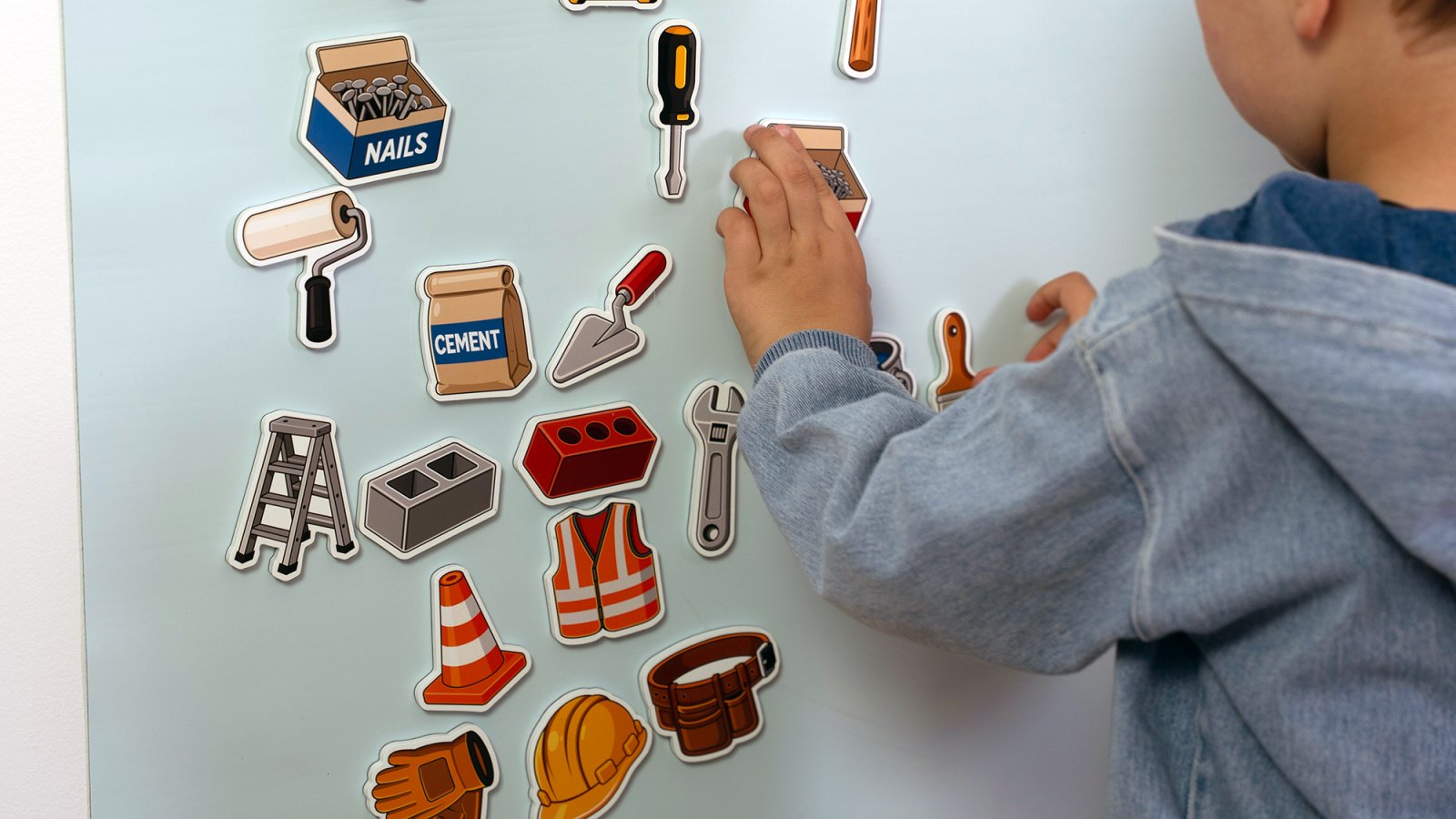
Try one of these this week:
- Story scene: Set out a few pieces and ask, "What is happening here?"
- Shop game: Bowls, spoons and paper money become a café.
- Build and rebuild: Boxes and tubes become a tower, then a tunnel.
- Small world: Arrange figures and props and let your child move them around.
- Quiet basket: A tin of pieces for calm time on the sofa or at the table.
Keep each session short. Fifteen to twenty minutes of focused play beats an hour of wandering.
A 2025 study in the National Library of Medicine's PubMed Central on children's loose-parts play looked at how indoor loose-parts play relates to learning processes, which supports what many parents see: open materials invite thinking, not just filling time.
Say less than you think you should. The child is the director here.
How to Encourage Independent Play Without Directing
Independent play grows when you become boring on purpose. Sit nearby, stay quiet, and let your child solve the small problems alone.
A common mistake is jumping in too fast. Every time you fix the tower or name the character, you take a turn away from your child.
Try this approach:
- Set up the space, then sit back with your own book
- Answer questions with a question: "What do you think?"
- Praise effort, not the result: "You kept trying"
- Let quiet stretches last, even when they feel long
The goal is not to leave your child alone. It is to be present without steering.
If your child asks you to play, join briefly, then step out again. Our independent play checklist helps you put this stepping-back advice into practice at home. Short exits build confidence over weeks, not days.
Common Mistakes That Shut Play Down
Even well-meaning parents can stop play without realising it. Here are the ones we see most often.
- Too many toys out at once. Clutter scatters attention. Rotate and store the rest.
- Asking too many questions. Constant quizzing turns play into a test.
- Correcting the play. If the cow is flying, the cow is flying. Let it be.
- Packing up too soon. Give a five-minute warning before tidy-up.
- Filling every quiet moment. Boredom is where new ideas start.
Each of these is easy to fix. The trick is noticing the habit first.
If you are unsure whether a toy or setup fits this approach, our FAQs page answers common questions parents ask.
Conclusion
Building open-ended play at home takes a calm space, a few good materials and a willingness to step back. The rewards show up in longer, richer play and a child who trusts their own ideas.
At Tiny Worlds, we make magnetic play sets designed for exactly this kind of play. Our sets are chunky and easy to grip for little hands, built to last, and made to mix together as a collection grows. Every piece is made for children aged 3 and up.
Ready to start? Explore our play sets and give your child a little world to invent in.
